
Read the Lesson then Take the Quiz
Hydraulic jumps are striking and highly energetic phenomena that occur in open channel flows when water transitions abruptly from a high-velocity, shallow flow to a slower, deeper flow. This sudden change is not only visually dramatic, often appearing as a turbulent roller or standing wave, but also critically important in hydraulic engineering. Hydraulic jumps play a central role in dissipating excess energy, protecting structures from erosion, and controlling flow conditions downstream of spillways, sluice gates, and other hydraulic structures. Understanding their physics, classification, and practical applications are essential for designing safe and efficient open channel systems.
In the photograph below, a horizontal rectangular channel shows a demonstration of a hydraulic jump. Water is recirculated through the channel using a pump located under the device. Water flows from the left where it backs up against a sluice gate. A sluice gate is a wall in the channel obstructing the flow but with a roughly 1 inch opening underneath it. Water flows under the sluice gate at high velocity. At the far right end of the channel, not in the photograph, there is a gate (about 5 inches high) that the water flows over. Water transitions from a depth of around 1 inch to a depth slightly higher than the gate by having a hydraulic jump. Though the flowrate is constant in the channel, the velocity is high at location 1 due to the small water depth and much lower at location 2 due to the greater depth.
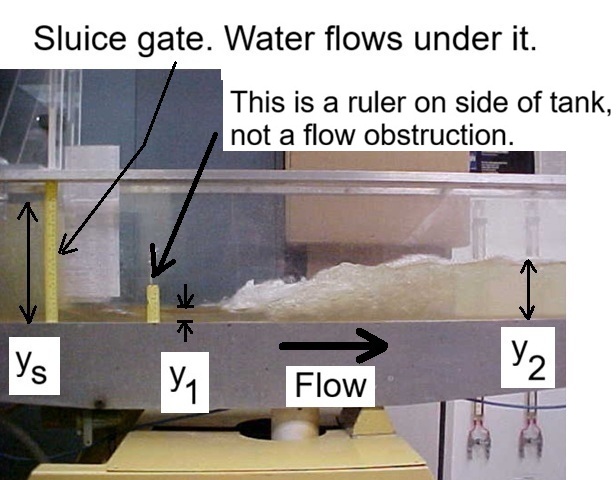
Hydraulic Jump in Rectangular Horizontal Channel in Laboratory. Flow from Left to Right. Ohio University Fluid Dynamics Laboratory.
In the figure:
ys = Water depth upstream of sluice gate.
y1 = Water depth upstream of hydraulic jump.
y2 = Water depth downstream of hydraulic jump.
In open channel flow, the behavior of water is strongly influenced by gravity, channel geometry, and flow depth. A key dimensionless parameter used to describe this behavior is the Froude number, defined as the ratio of inertial forces to gravitational forces. When the Froude number is greater than one, the flow is said to be supercritical, meaning it is fast and shallow, and disturbances cannot easily propagate upstream. When the Froude number is less than one, the flow is subcritical, characterized by slower, deeper conditions where surface disturbances can travel both upstream and downstream. A hydraulic jump occurs when a supercritical flow is forced to transition to a subcritical state, typically due to a change in channel slope, roughness, or a downstream control such as the flow going under a gate.
The transition from supercritical to subcritical flow in a hydraulic jump is analyzed by the conservation of mass and momentum. Energy is conserved, but the energy loss is difficult to predict because a significant portion is dissipated as turbulence. Upstream of the jump, the flow is relatively smooth and shallow, with high velocity and low depth. At the jump, the water surface rises abruptly, forming a highly turbulent roller where air is entrained and large eddies are generated. Downstream of the jump, the flow becomes deeper and slower, with a more uniform and tranquil appearance. This redistribution of energy and momentum is essential for stabilizing the flow and reducing the risk of erosion and structural damage.
The relationship between the depths upstream and downstream of a hydraulic jump, often called conjugate depths, can be derived from the momentum equation. For given upstream conditions, there is a corresponding downstream depth that satisfies momentum conservation. The difference in specific energy between these two states represents the energy lost in the jump. This energy loss is desirable in many engineering applications because it reduces the destructive potential of high-velocity flows. Designers often intentionally create conditions that promote a stable hydraulic jump in a designated stilling basin, where the channel is reinforced to withstand intense turbulence.
Hydraulic jumps can be classified into several types based on the upstream Froude number and the resulting flow pattern. For low supercritical upstream Froude numbers just above one, the jump may be weak, with only a modest rise in water surface and limited turbulence. As the upstream Froude number increases, the jump becomes more pronounced and energetic, evolving into what is commonly known as an oscillating or undular jump, and eventually into a fully developed, steady jump with a strong roller and intense mixing. At very high Froude numbers, the jump can become unstable and may sweep downstream, making it difficult to control. These classifications help engineers anticipate the behavior of the jump and design appropriate energy dissipation structures.
The practical importance of hydraulic jumps is most evident near hydraulic structures such as spillways, outlet works, and sluice gates. When water is released from a reservoir through a spillway, it often accelerates down a steep chute, reaching supercritical velocities at the toe of the structure. If this high-velocity jet were allowed to continue unchecked, it could cause severe scour of the riverbed and undermine the stability of the dam or channel. By providing a stilling basin with appropriate geometry and sometimes additional appurtenances such as baffle blocks or end sills, engineers can force the formation of a hydraulic jump at a specific location. The jump dissipates much of the kinetic energy, reducing velocities to levels that the downstream channel can safely convey.
In addition to energy dissipation, hydraulic jumps contribute to mixing and aeration in open channels. The intense turbulence and air entrainment within the roller promote oxygen transfer between the atmosphere and the water. This can be beneficial for improving water quality in rivers and canals, particularly downstream of dams where water may have low dissolved oxygen. However, the same turbulence can also pose hazards to navigation and to people or animals that might be caught in the recirculating flow. For this reason, safety considerations are an important part of hydraulic jump design, including the placement of warning signs, barriers, and access restrictions near stilling basins.
The prediction and analysis of hydraulic jumps rely on a combination of theoretical, experimental, and numerical approaches. Classical hydraulic theory provides analytical relationships for conjugate depths and energy loss in simple channel geometries, especially rectangular channels with uniform flow. Laboratory experiments using flumes allow researchers and students to observe hydraulic jumps directly, measure flow depths and velocities, and validate theoretical predictions. In modern practice, computational fluid dynamics models are increasingly used to simulate complex jump behavior in non-rectangular channels, and around appurtenances. These tools help engineers refine designs and anticipate performance under a range of operating scenarios.
Despite their apparent simplicity, hydraulic jumps embody many fundamental principles of fluid mechanics, including the role of dimensionless parameters, the interplay of inertia and gravity, and the mechanisms of turbulence and energy dissipation. They serve as a classic example in hydraulic engineering education, bridging the gap between theory and practice. By studying hydraulic jumps, engineers gain insight into how to manage high-energy flows, protect infrastructure, and harness natural processes for beneficial purposes. Whether observed as a foaming roller below a spillway or as a subtle standing wave in an irrigation canal, hydraulic jumps remain a powerful and practical manifestation of open channel flow dynamics.
Multiple Choice Quiz
1. In open channel flow, a hydraulic jump most commonly represents the transition between which two flow regimes?
A. Subcritical to supercritical flow.
B. Laminar to turbulent flow.
C. Uniform to non-uniform flow.
D. Supercritical to subcritical flow.
2. The dimensionless parameter primarily used to characterize the occurrence of hydraulic jumps in open channels is the:
A. Froude number.
B. Reynolds number.
C. Mach number.
D. Weber number.
3. In a hydraulic jump, the primary reason that the energy equation is not typically used for analysis is that energy is:
A. Converted entirely into potential energy.
B. Lost due to wall friction only.
C. Dissipated by means that are difficult to quantify.
D. Stored as pressure energy in the roller.
4. The pair of water depths immediately upstream and downstream of a hydraulic jump that are related by the momentum equation are known as:
A. Critical depths.
B. Normal depths.
C. Conjugate depths.
D. Sequent velocities.
5. In practical dam and spillway design, the main engineering purpose of intentionally forming a hydraulic jump in a stilling basin is to:
A. Increase the discharge capacity of the spillway.
B. Raise the upstream reservoir level.
C. Reduce sediment deposition in the reservoir.
D. Dissipate excess kinetic energy and prevent downstream erosion.
Type your answers in the box to help remember them, before hovering over the answers:
Answers
Equations and calculators can be found at our pages:
Hydraulic jump in horizontal rectangular open channel
Hydraulic jump in sloped pipe or circular culvert
Lesson and questions generated in part by Microsoft Copilot AI. The AI-generated portions were verified by Ken Edwards, Ph.D., P.E. of LMNO Engineering, Research, and Software, Ltd. Ken can be contacted at the email and phone number below.
© 2026 LMNO Engineering, Research, and Software, Ltd. All rights reserved.
LMNO Engineering, Research, and Software, Ltd.
7860 Angel Ridge Rd. Athens, Ohio 45701 USA Phone: (740) 707‑2614
LMNO@LMNOeng.com
https://www.LMNOeng.com