
Read the Lesson then Take the Quiz
Detention basins are engineered structures designed to temporarily store stormwater runoff and release it at a controlled rate. They are a central tool in modern stormwater management, especially in urban and suburban areas where impervious surfaces such as roads, parking lots, and rooftops prevent rainfall from infiltrating into the ground. Without some form of control, stormwater can rapidly accumulate and flow into downstream channels, causing flooding, erosion, and damage to infrastructure and ecosystems. Detention basins address this problem by capturing runoff during and immediately after a storm, holding it for a limited period, and then discharging it more slowly so that peak flows are reduced and downstream systems are less stressed.
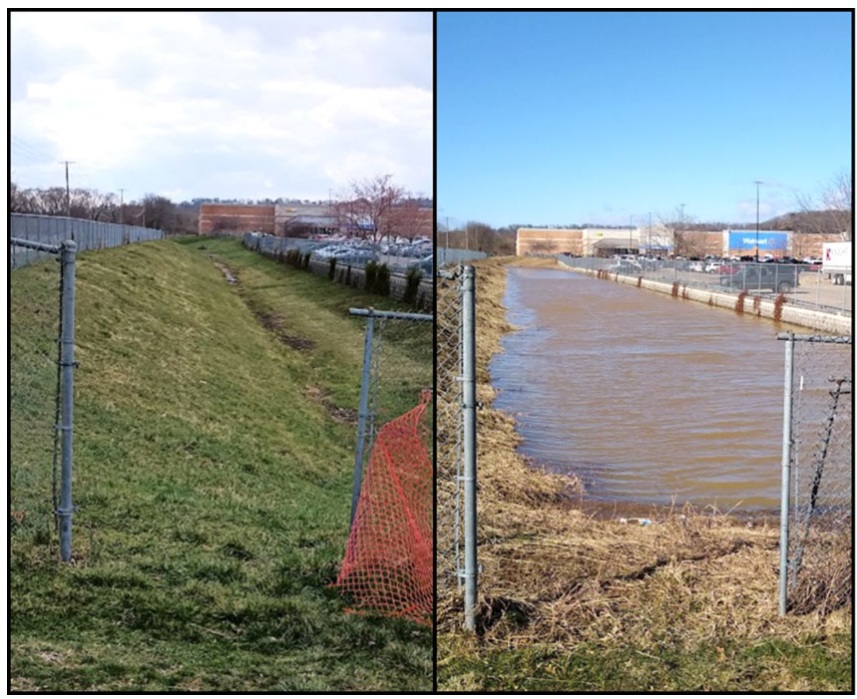
Unlike retention basins, which maintain a permanent pool of water between storm events, detention basins are typically dry most of the time. They are sometimes called dry ponds or dry detention basins because they are designed to drain completely after a storm, leaving only a gently sloped depression or open space. During a rainfall event, stormwater enters the basin through inlets or swales and begins to fill the storage volume. An outlet structures, often consisting of an orifice, weir, or combination of openings, helps control the rate that water can leave the basin. By carefully sizing this outlet relative to the expected inflow, engineers can shape the outflow hydrograph so that the maximum discharge is significantly lower than it would be without the basin.
The primary purpose of a detention basin is flood control. By shaving off the peak of the runoff hydrograph, these basins reduce the likelihood that downstream channels, culverts, and storm sewers will be overwhelmed. This is particularly important in developed watersheds where natural floodplains have been encroached upon and where existing drainage infrastructure may have limited capacity. Detention basins can protect homes, businesses, roads, and utilities from flood damage, and they are often required by local regulations as part of new developments. Many communities specify that post-development peak flows for certain design storms, such as the two-year, 10-year, or 100-year storm, must not exceed pre-development peak flows. Detention basins are a common way to meet these regulatory criteria.
In addition to flood control, detention basins can provide some degree of water quality improvement. As stormwater is detained, suspended sediments and associated pollutants have time to settle to the bottom of the basin. This settling process can reduce the concentration of particulate-bound contaminants such as phosphorus, heavy metals, and hydrocarbons before the water is released downstream. However, because detention basins are usually dry between storms and do not maintain a permanent pool, their water quality performance is generally more limited than that of wet ponds or retention basins. For this reason, they are sometimes combined with other best management practices, such as vegetated swales, bioretention areas, or infiltration practices, to achieve more comprehensive treatment.
The design of a detention basin begins with a hydrologic analysis of the contributing drainage area. Engineers determine how much runoff will be generated by different storm events, taking into account land use, soil type, slope, and rainfall intensity. Once the inflow hydrograph is known, the required storage volume of the basin can be determined by comparing inflow and outflow over time. The basin must be large enough to store the temporary excess of inflow over outflow during the peak of the storm. The shape, depth, and side slopes of the basin are then determined to provide this volume while maintaining stability, safety, and compatibility with the surrounding site.
Site conditions strongly influence detention basin design. Topography affects where a basin can be located and how easily runoff can be conveyed to it by gravity. Soil characteristics influence how quickly any incidental infiltration might occur and whether a liner is needed to protect groundwater in areas with contaminated runoff. Available land area is often a limiting factor, especially in dense developments, because detention basins require a relatively large footprint. Designers must also consider how the basin will fit into the overall layout of a site, including access roads, buildings, utilities, and open space. In some cases, basins are integrated into parks or greenbelts so that they serve both functional and recreational purposes.
Maintenance is critical to the long-term performance of detention basins. Over time, sediments and debris accumulate in the basin, particularly near inlets and outlets. If not removed periodically, this buildup can reduce storage capacity and clog outlet structures, undermining the basin's ability to control peak flows. Routine inspections are needed to check for erosion, damage to structures, excessive vegetation growth, or signs of standing water that persists longer than intended. Maintenance activities may include mowing, sediment removal, trash cleanup, repair of erosion, and occasional rehabilitation of the outlet works.
Detention basins also have limitations. Because they are primarily designed for peak flow control, they may not significantly reduce the total volume of runoff or address dissolved pollutants. In watersheds where water quality is a major concern, or where groundwater recharge is desired, other practices such as infiltration basins, permeable pavements, or constructed wetlands may be more appropriate or may need to be used in combination with detention. Furthermore, in very flat areas or regions with high groundwater tables, it can be challenging to provide adequate storage and drainage without causing nuisance ponding. Climate change, with its potential to alter rainfall patterns and increase the frequency of intense storms, adds another layer of complexity, requiring designers to think carefully about how detention basins will perform under future conditions.
Despite these challenges, detention basins remain a widely used and versatile component of stormwater management systems. They offer a relatively straightforward way to mitigate the hydrologic impacts of development, protect downstream communities from flooding, and provide some ancillary benefits for water quality and habitat. When thoughtfully sited, carefully designed, and properly maintained, detention basins can function as both infrastructure and landscape, quietly working in the background to manage the pulse of stormwater that accompanies every significant rain.
Multiple Choice Quiz
1. The primary purpose of a detention basin in a stormwater management system is to:
A. Permanently store stormwater and create a recreational water body
B. Infiltrate all stormwater into the ground to recharge groundwater
C. Temporarily store runoff and release it at a controlled rate to reduce peak flows
D. Divert stormwater directly into natural streams without delay
2. A key difference between a detention basin and a retention basin is that a detention basin:
A. Always contains a permanent pool of water between storms
B. Is designed only for water quality improvement and not for flood control
C. Is typically dry between storm events and drains completely after storms
D. Cannot be used in urban or suburban developments
3. In designing a detention basin, the required storage volume is primarily determined by:
A. The color and type of vegetation planted around the basin
B. Comparing the inflow and outflow hydrographs to store excess inflow during peak periods
C. The number of nearby buildings and parking spaces
D. The average daily temperature of the region
4. One important maintenance concern for detention basins that can reduce their effectiveness over time is:
A. Accumulation of sediment and debris that can reduce storage and clog outlets
B. The presence of native plants that stabilize soil and provide habitat
C. The gentle side slopes that allow safe access for maintenance equipment
D. The use of hydrologic methods such as the Rational Method in design
5. A limitation of detention basins, compared to some other stormwater practices, is that they:
A. Are unable to reduce peak flow rates during storm events
B. Always require a permanent pool that can attract mosquitoes
C. Cannot be integrated into parks or open space for dual use
D. May provide limited water quality treatment and do not significantly reduce total runoff volume
Type your answers in the box to help remember them, before hovering over the answers:
Answers
More details about the detention basin storage can be found on our detention storage volume calculator page
Lesson and questions generated in part by Microsoft Gemini AI. The AI-generated portions were verified by Ken Edwards, Ph.D., P.E. of LMNO Engineering, Research, and Software, Ltd. Ken can be contacted at the email and phone number below.
© 2026 LMNO Engineering, Research, and Software, Ltd. All rights reserved.
LMNO Engineering, Research, and Software, Ltd.
7860 Angel Ridge Rd. Athens, Ohio 45701 USA Phone: (740) 707‑2614
LMNO@LMNOeng.com
https://www.LMNOeng.com