
Read the Lesson then Take the Quiz
The Rational Method is one of the most widely used techniques in hydrology for estimating peak discharge from small drainage areas. Developed in the nineteenth century and still commonly applied in modern engineering practice, the method provides a simple yet effective way to relate rainfall intensity to runoff. Its enduring relevance lies in its practicality, especially for preliminary design and analysis of stormwater infrastructure such as culverts, storm sewers, and small detention basins. Despite its simplicity, the Rational Method is grounded in key hydrologic principles that connect rainfall characteristics, watershed properties, and runoff response.At its core, the Rational Method is expressed through the equation Q = CiA, where Q represents the peak discharge, C is the runoff coefficient, i is the rainfall intensity, and A is the drainage area. Each of these variables encapsulates important physical characteristics of the watershed and the storm event. The peak discharge, typically expressed in cubic feet per second or cubic meters per second, is the maximum rate of runoff expected during a rainfall event. The runoff coefficient reflects the fraction of rainfall that becomes direct runoff based on the infiltration characteristics of the ground surface. Rainfall intensity is defined as the rate of precipitation over a specified duration, while the drainage area represents the size of the contributing watershed.
The runoff coefficient is perhaps the most subjective component of the Rational Method. It varies depending on land use, soil type, slope, and degree of imperviousness. Urban areas with extensive pavement and rooftops tend to have high runoff coefficients, often ranging from 0.7 to 0.95, because most rainfall becomes surface runoff. In contrast, rural or undeveloped areas with permeable soils and vegetation typically have lower coefficients, sometimes as low as 0.1 to 0.3. Engineers often rely on tabulated values or empirical guidelines to select appropriate coefficients, but judgment is required to account for site-specific conditions.
Rainfall intensity is typically obtained from intensity-duration-frequency (IDF) curves, which are developed using historical precipitation data. These curves provide rainfall intensities for various storm durations and return periods, allowing engineers to select a design storm that reflects an acceptable level of risk. For example, a storm with a return period of 25 years has a four percent chance of being equaled or exceeded in any given year. The choice of return period depends on the importance of the structure being designed and the consequences of failure. Critical infrastructure may require larger return periods, while less critical systems may be designed for more frequent events.
An IDF curve for Hamilton, Ohio, is shown below with red circles added by LMNO Engineering. Note that it has logarithmic x- and y-axes, which is typical of IDF curves. As an example of reading the figure, a storm with a 5-year return period and 6-hour duration has a rainfall intensity of 0.4 inches per hour. A storm with a 5-year return period and duration of only 8 minutes has a much higher intensity of 5.0 inches per hour. Short duration storms are cloud bursts that drop high intensities (inches per hour) but often low rainfall depths (inches) of rain - due to the short time period. Source of IDF curve
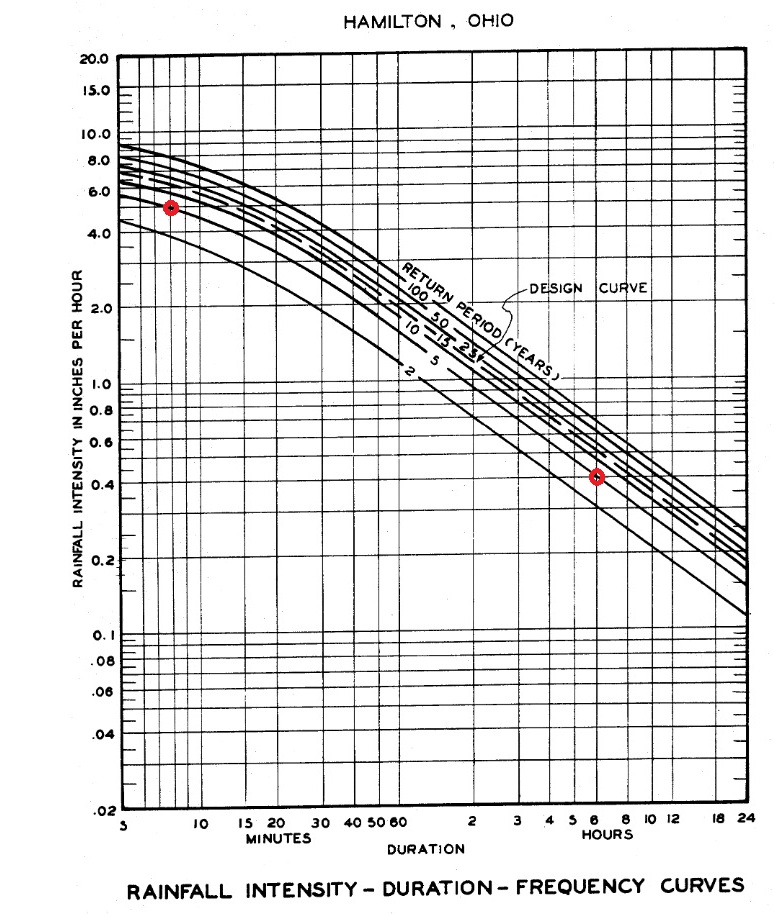
An important concept underlying the Rational Method is the time of concentration, which is the time required for water to travel from the most hydraulically distant point in the watershed to the outlet. The rainfall intensity used in the equation must correspond to a storm duration equal to the time of concentration. This ensures that the entire watershed is contributing to runoff at the moment peak discharge occurs. Viewing an IDF curve such as shown above, rainfall intensity increases as duration decreases. If a storm duration less that of the time of concentraion is used as the storm duration, then a too-high value for rainfall intensity would be selected leading to an over-estimate of peak discharge. Conversely, using a longer duration would result in selecting a too-low value for rainfall intensity resulting in a low peak discharge calculation.
The drainage area used in the Rational Method must be carefully delineated to ensure accurate results. This involves identifying the boundaries of the watershed and determining how water flows across the landscape. Factors such as topography, drainage patterns, and man-made features like roads and storm drains all influence the contributing area. For small, well-defined catchments, this process is relatively straightforward. However, in more complex urban environments, delineation can become challenging and may require detailed mapping.
One of the key assumptions of the Rational Method is that rainfall intensity is uniform over the entire drainage area and constant for the duration of the storm. While this assumption simplifies calculations, it may not always reflect real-world conditions, where rainfall can vary spatially and temporally. Additionally, the method assumes that the runoff coefficient remains constant throughout the storm, even though factors such as soil saturation can change over time. These simplifications limit the method's accuracy, particularly for larger or more complex watersheds.
Despite its limitations, the Rational Method remains a valuable tool for estimating peak discharge in small watersheds, typically less than 200 acres in size. Its simplicity allows for quick calculations and makes it particularly useful in preliminary design stages or when data availability is limited. However, for larger or more complex systems, more sophisticated hydrologic models may be required to capture the dynamics of runoff more accurately. These models can account for variable rainfall patterns, storage effects, and nonlinear responses that the Rational Method does not represent.
Another important consideration when using the Rational Method is the impact of urbanization. As land is developed, natural surfaces are replaced with impervious materials, increasing the runoff coefficient and reducing the time of concentration. This leads to higher peak discharges and greater risk of flooding. Engineers must account for these changes when designing stormwater systems, often incorporating mitigation measures such as detention basins, green infrastructure, or permeable pavements to manage runoff.
In practice, the Rational Method is often applied in conjunction with local design standards and regulations. Many municipalities provide guidelines for selecting runoff coefficients, determining time of concentration, and choosing appropriate return periods. These standards help ensure consistency and reliability in stormwater design. However, engineers must still exercise professional judgment and consider site-specific factors that may not be fully captured by standard procedures.
The method also plays a role in risk assessment and infrastructure planning. By estimating peak discharge, engineers can evaluate the capacity of existing systems and identify potential deficiencies. This information is critical for prioritizing upgrades and ensuring that infrastructure can withstand future storm events. With increasing concerns about climate change and more intense rainfall patterns, the importance of accurate peak discharge estimation has become even more pronounced.
In conclusion, the Rational Method is a foundational tool in hydrology that provides a straightforward approach to estimating peak discharge from small drainage areas. Its reliance on key variables such as runoff coefficient, rainfall intensity, and drainage area allows engineers to link watershed characteristics with storm behavior. While the method has limitations due to its simplifying assumptions, it remains widely used because of its practicality and ease of application. Understanding its principles, assumptions, and appropriate use is essential for effective stormwater management and infrastructure design.
Multiple Choice Quiz
1. What does the variable C represent in the Rational Method equation?A. Runoff coefficient
B. Rainfall intensity
C. Drainage area
D. Peak discharge
2. Why must rainfall intensity correspond to the time of concentration?
A. To reduce calculation complexity
B. To match average annual rainfall
C. To ensure the entire watershed contributes to runoff
D. To minimize runoff coefficient errors
3. Which factor most directly increases the runoff coefficient?
A. Increased vegetation
B. More impervious surfaces
C. Lower rainfall intensity
D. Larger drainage area
4. What is a major limitation of the Rational Method?
A. It cannot estimate peak discharge
B. It requires advanced computer modeling
C. It only applies to large watersheds
D. It assumes uniform rainfall intensity
5. For what type of watershed is the Rational Method most appropriate?
A. Large river basins
B. Mountainous terrain
C. Small drainage areas
D. Coastal floodplains
Type your answers in the box to help remember them, before hovering over the answers:
Answers
More details about the Rational Method can be found on our Rational Method calculator page
Lesson and questions generated in part by chatGPT AI. The AI-generated portions were verified by Ken Edwards, Ph.D., P.E. of LMNO Engineering, Research, and Software, Ltd. Ken can be contacted at the email and phone number below.
© 2026 LMNO Engineering, Research, and Software, Ltd. All rights reserved.
LMNO Engineering, Research, and Software, Ltd.
7860 Angel Ridge Rd. Athens, Ohio 45701 USA Phone: (740) 707‑2614
LMNO@LMNOeng.com
https://www.LMNOeng.com