
Units: cm=centimeter, ft=foot, g=gram, gal=U.S. gallon, hr=hour, kg=kilogram, km=kilometer, lb=pound, m=meter, min=minute, N=Newton, Pa=Pascal, psi=lb/inch2, s=second
Types of Pressure Taps for Large Bore Differential Pressure Orifice Flow Meter
Introduction
Orifice plate flow rate meters are used to determine a liquid or gas pipe flow rate by measuring the
differential pressure (P1 - P2) across the orifice plate. Orifice meters
are generally less expensive to install and manufacture than the other commonly used
differential pressure pipe flow rate meters; however, nozzle and venturi pipe flow rate meters have the advantage of lower pressure drops.
Equations for orifice meters have the advantage of no Reynolds Number upper limit
for validity.
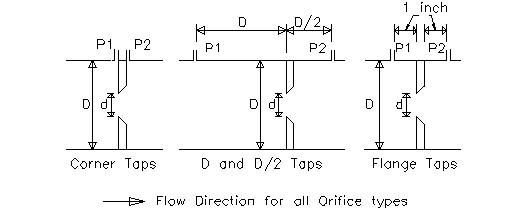
An orifice pipe flow rate meter is typically installed between flanges connecting two pipe sections (flanges are not shown in the above drawings). The three standard pressure tapping arrangements are shown in the drawings; the location of the pressure taps affects the discharge coefficient somewhat. Flange pressure taps penetrate the flange and are at a standard distance of 1 inch (2.54 cm) from either side of the orifice. For corner taps or D and D/2 taps, the pressure tap locations are as shown.
Orifices are typically less than 0.05D thick. For exact geometry and specifications for orifices, see ISO (1991) or ASME (1971). The ASME and ISO have been working on guidelines for orifices for pipe flow rate measurement since the early 1900s. The organizations have the most confidence in orifice accuracy when the Reynolds number exceeds 105, though Reynolds numbers as low as 4x10³ are valid for certain d/D ratios as discussed below. The pipe flow rate calculation above is for liquids. Orifice gas pipe flow rate calculations (D<5 cm, D≥5 cm) have an additional factor called expansibility.
Equations
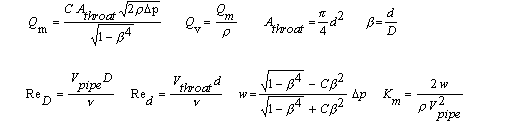
The pipe flow rate calculations on this page are for orifices carrying a liquid as described in ISO (1991) and ASME (1971). The ISO reference has a more
up-to-date discussion of orifices than the ASME reference, so the ISO equations are used
in our pipe flow rate calculations.
Varible Definitions
[L]=Length units, [F]=Force units, [M]=Mass units, [T]=Time units.
A = Area [L2], C = Discharge Coefficient, d = Throat Diameter [L], D = Pipe Diameter [L],
h = Head Loss [L],
k = Equivalent Roughness of Pipe Material [L],
Km = Minor Loss Coefficient,
Δp = Differential Pressure [F/L2], Qm = Mass Flow Rate [M/T], Qv = Volumetric Flow Rate [L3/T], Red = Reynolds Number based on d, ReD = Reynolds Number based on D, V = Velocity [L/T],
w = Pressure Loss [F/L2],
ρ = Density [M/L3], ν = Kinematic Viscosity [L2/T].
w is the static pressure loss occurring from a distance of approximately D upstream of the orifice to a distance of approximately 6D downstream of the orifice. It is not the same as differential pressure. Differential pressure is measured at the exact locations specified in ISO (1991) (shown in the above figures). Km is computed to allow you to design pipe systems with orifices and incorporate their head loss. Head loss is computed as h=KmV2/(2g) where V is the pipe velocity.
Discharge Coefficients (ISO, 1998)
Equation and applicability:
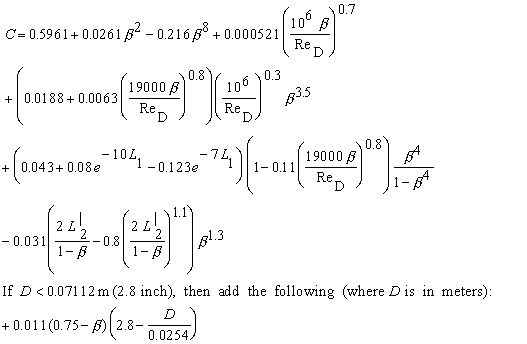
Corner Pressure Taps: L1 = L'2 = 0
D and D/2 Pressure Taps: L1 = 1 and L'2 = 0.47
Flange Pressure Taps: L1 = L'2 = 0.0254/D where D is in
meters
Applicability:
All types of pressure taps: d ≥ 1.25 cm, 5 cm ≤ D ≤ 1 m, 0.1
≤ d/D ≤ 0.75
Corner Pressure Taps or D and D/2 Pressure Taps:
ReD ≥ 4000 for 0.1 ≤ d/D ≤ 0.5
and ReD ≥ 16,000(d/D )2 for d/D>0.5
Flange Pressure Taps: ReD ≥ 4000 and ReD ≥ 170,000 D (d/D )2 where D is in meters
In addition, ISO recommends that in general k/D ≤ 3.8x10⁻⁴
for Corner Taps and k/D ≤ 10-3 for Flange or D and D/2 pressure
taps. k is the pipe roughness.
Error Messages
"All inputs must be positive". This is an initial check of user
input to the pipe flow rate calculator.
"d, D, d/D, or ReD out of range". The equation for discharge coefficient,
C, is only valid for certain ranges of d, D, d/D, and ReD as shown in the Discharge Coefficients section above. This message could be
generated during the pipe flow rate program's initial check for valid input. If the input is valid,
the message will be generated during computations if the program determines that a
calculated value will be out of range of the validity of the equations. d is orifice
diameter, D is pipe diameter, and ReD is the Reynolds number based on D.
"ReD is too small". During computations, it has been determined that ReD will not
be large enough to satisfy the validity equations.
• Try the simpler orifice pipe flow rate calculation on our Bernoulli page if your parameters are out of range. It
is not as accurate, but won't give "parameter out of range" error messages.
References
American Society of Mechanical Engineers (ASME). 1971. Fluid meters: Their
theory and application. Edited by H. S. Bean. 6ed. Report of ASME
Research Committee on Fluid Meters.
International Organization of Standards (ISO 5167-1). 1991. Measurement of fluid flow by means of pressure differential devices, Part 1: Orifice plates, nozzles, and Venturi tubes inserted in circular cross-section conduits running full. Reference number: ISO 5167-1:1991(E).
International Organization of Standards (ISO 5167-1) Amendment 1. 1998. Measurement of fluid flow by means of pressure differential devices, Part 1: Orifice plates, nozzles, and Venturi tubes inserted in circular cross-section conduits running full. Reference number: ISO 5167-1:1991/Amd.1:1998(E).
© 1999-2026 LMNO Engineering, Research, and Software, Ltd. All rights reserved.
LMNO Engineering, Research, and Software, Ltd.
7860 Angel Ridge Rd. Athens, Ohio 45701 USA Phone: (740) 707‑2614
LMNO@LMNOeng.com
https://www.LMNOeng.com