
Units:
cm=centimeter, cfs=cubic foot per second, cms=cubic meter per second, ft=foot, gal=gallon (U.S.), m=meter, min=minute, s=second, yr=year
Drawings and Equations
Introduction
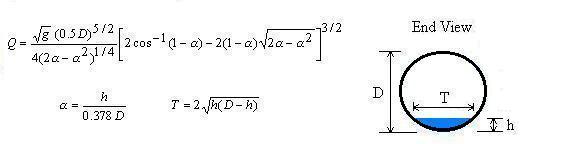
Discharge (flow rate) can be computed for water flowing out of a circular culvert that is
up to half full. The end depth method is based on the International Organization of
Standards publication 4371 dated 1984 (ISO, 1984). Knowing
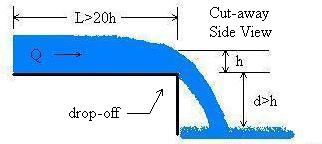
the culvert diameter and the depth of flow where the water drops off (i.e. at the end of
the culvert), the discharge can be computed. If it is more easy or accurate to
measure the water top width at the drop-off (instead of water depth), the top width can be
used with diameter to compute the discharge. For the equation to be used properly,
there are several criteria that should be met:
• Clear water.
• Circular cross-section for a distance at least 20h upstream of the drop-off.
• Culvert should be horizontal although a slight downward slope (up to 1/2000) is okay.
• Culvert walls should be smooth such as would be provided by a neat cement finish.
• Flow should be sub-critical upstream of the drop-off.
• The drop, d, should be greater than h.
• The channel width, T, should be greater than 0.3 m (11.8 inch).
• The end depth, h, should be greater than 0.05 m (1.97 inch).
• The ratio h/D should be between 0.095 and 0.5, and cannot exceed 0.5.
Variables
[L] indicates length units. [T] indicates time units.
d=Drop elevation [L]. Elevation difference between bottom of channel and tail
water. Must be at least h for the discharge equation to be reliable.
D=Culvert diameter [L]. Note that h/D must be between
0.095 and 0.5 for the discharge equation to be reliable. The calculation only
functions for h/D≤0.5.
g=Acceleration due to gravity=9.8066 m/s2.
h=Measured water depth at end of channel (i.e. at the drop-off) [L]. Must
be greater than 0.05 m (1.97 inch) for the discharge equation to be reliable. Note
that h/D must be between 0.095 and 0.5 for the discharge equation to be reliable.
The calculation only functions for h/D≤0.5.
L=Straight length upstream of drop-off [L]. Must be at least 20h
for the flow to be well-established.
Q=Discharge [L3/T]. Also known as flow rate.
T=Top width of water in the culvert [L]. Must be greater than 0.3 m (11.8
inch) for the discharge equation to be reliable.
Error Messages
Messages indicating input values are out of the acceptable ranges (the seemingly redundant
messages are checked at different phases of program execution):
"D must be > 0",
"h must be > 0",
"h/D must be ≤ 0.5",
"Must have 0< h/D ≤ 0.5",
"T must be > 0",
"T must be ≤ D",
"Enter 1e-5 ≤ D ≤ 1000 m",
"Enter 1e-7 ≤ h/D ≤ 0.5",
"Enter 1e-5 ≤ h ≤ 1000 m".
The calculation finished, but per ISO (1984), equation accuracy is reduced when the following messages appear:
"Need h/D > 0.095 for accuracy",
"Need h > 0.05 m for accuracy",
"Need T > 0.3 m for accuracy".
Reference
International Organization of Standards (ISO 4371). 1984. Measurement of
liquid flow in open channels by weirs and flumes - End depth method for estimation of flow
in non-rectangular channels with a free overfall (approximate method). Reference
number: ISO 4371-1984(E).
© 2000-2026 LMNO Engineering, Research, and Software, Ltd. All rights reserved.
LMNO Engineering, Research, and Software, Ltd.
7860 Angel Ridge Rd. Athens, Ohio 45701 USA Phone: (740) 707-2614
LMNO@LMNOeng.com
https://www.LMNOeng.com