
Units: cfs=cubic foot per second, cm=centimeter, ft=foot, gal=U.S. gallon, gpd=U.S. gallon per day, gpm=U.S. gallon per mimute, hp=horsepower, lb=pound, m=meter, min=minute, N=Newton, Pa=Pascal, psi=lb/inch2, s=second
Topics: Scenarios Equations Hazen-Williams Coefficients Minor Loss Coefficients Common Questions References
Introduction
Water, the essence of life, journeys through a complex network of pipes that crisscross cities, towns, and homes, ensuring its availability at every turn of a tap. The flow of water through pipes is a marvel of engineering and a cornerstone of modern civilization, facilitating essential tasks from hydration to sanitation to industrial development to power generation. The flow of water through pipes is governed by principles of fluid dynamics. Pipes are designed to withstand pressure and maintain structural integrity over decades. The diameter of pipes, along with the material chosen, directly impacts the flow rate and efficiency of water flow.
Pressure plays a major role in how water moves through pipes. In a municipal water system, water is pressurized before entering the network of pipes. This pressure ensures that water reaches its destination for a household faucet or an industrial plant, with adequate force. While pumps create pressure to move water through pipes, gravity also plays a significant role in some systems, particularly in distributing water from higher reservoirs to lower-lying areas. Gravity-fed systems capitalize on elevation differences, reducing the need for extensive pumping infrastructure and minimizing energy consumption.
In residential and commercial settings, the flow of water through pipes is engineered to meet specific needs. Water enters buildings through main supply lines, branching off into smaller pipes that deliver water to individual fixtures such as sinks, showers, and toilets. The diameter of these pipes and their layout within the building are crucial factors in maintaining adequate water pressure and flow rate for all uses.
Despite its fundamental importance, the flow of water through pipes is not without challenges. Issues such as leaks, corrosion, and sediment buildup can affect the efficiency and reliability of water distribution systems. Ongoing innovations in pipe materials, such as corrosion-resistant plastics and composite materials, as well as advances in monitoring technologies, contribute to more resilient and sustainable water infrastructure. In recent years, there has been a growing emphasis on sustainable water management and conservation. Efficient pipe design, coupled with water-saving fixtures and practices, helps minimize water wastage and reduce environmental impact. Furthermore, the modern instrumentation allows for real-time monitoring of water flow, enabling proactive maintenance and optimization of water distribution networks.
Discussion
Our water pipe calculator is valid for water flowing at typical temperatures found in municipal water supply systems (40 to 75 oF; 4 to 25 oC). The calculator is based on the steady state incompressible energy equation utilizing Hazen-Williams friction losses as well as minor losses. The Hazen-Williams friction loss method is commonly used by civil engineers for municipal water distribution system design. The calculator can compute flow rate, velocity, pipe diameter, elevation difference, pressure difference, pipe length, minor loss coefficient, and pump head (total dynamic head).
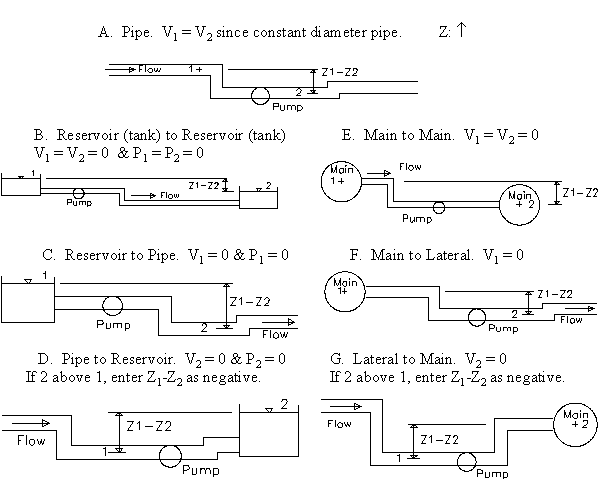
Piping Scenarios
Since boundary conditions affect the flow characteristics, our water pipe design calculator allows you to select whether your locations 1 and 2 are within pipes, at the surface of open reservoirs, or in pressurized mains (same as pressurized tank). If there is no pump between locations 1 and 2, then enter the pump head (Hp) as 0.
Steady State Energy Equation
Back to Calculation
The first equation shown is the steady state energy equation for incompressible flow. The left side of the equation contains what we call the driving head. These heads include heads due to a pump (if present), elevation, pressure, and velocity. The terms on the right side are friction loss and minor losses. Friction losses are computed in the water pipe design calculator using the Hazen-Williams friction loss equation. The energy equation is well-accepted in the field of fluid mechanics and can be found in many references such as Cimbala and Cengel (2008), Munson et al. (1998), and Streeter et al. (1998), while the Hazen-Williams equation for friction losses is well-established in the water supply literature and can be found in references such as Viessman and Hammer (1998) and Mays (1999).

The Hazen-Williams equation (the hf =... equation) is empirical and requires
that you use particular units as noted below. Though the other equations are dimensionally
correct, only units that can be used in all of the equations are shown below. Our
calculation allows you to enter a variety of units and automatically performs the unit
conversions.
ft=foot, lb=pound, m=meter, N=Newton, s=second
A = Pipe cross-sectional area, ft2 or m2.
C = Hazen-Williams pipe roughness coefficient. See
table below for values.
D = Pipe diameter, ft or m.
Driving Head (DH) = left side of the first equation (or right side of the equation), ft.
This is not total dynamic head.
g = acceleration due to gravity = 32.174 ft/s2 = 9.8066 m/s2.
hf = Major (friction) losses, ft or m.
hm = Minor losses, ft or m.
Hp = Pump head (also known as Total Dynamic Head), ft or m.
k = unit conversion factor = 1.318 for English units = 0.85 for Metric units
Km = Sum of minor loss coefficients. See table
below.
L = Pipe length, ft or m.
Pump Power (computed by program) = SQHp, lb-ft/s or N-m/s. Theoretical
pump power. Does not include an inefficiency term. Note that 1 horsepower = 550 ft-lb/s.
P1 = Upstream pressure, lb/ft2 or N/m2.
P2 = Downstream pressure, lb/ft2 or N/m2.
Q = Flow rate in pipe, ft3/s or m3/s.
S = Weight density of water = 62.4 lb/ft3 for English units = 9800 N/m3 for Metric
units
V = Velocity in pipe, ft/s or m/s.
V1 = Upstream velocity, ft/s or m/s.
V2 = Downstream velocity, ft/s or m/s.
Z1 = Upstream elevation, ft or m.
Z2 = Downstream elevation, ft or m.
All of the water pipe design equations on this page have analytic (closed form) solutions except for
"Solve for V, Q" and "Q known. Solve for Pipe Diameter." These
two calculations required a numerical solution. Our solution utilizes a modified
implementation of Newton's method that finds roots of the equations with the result
accurate to 8 significant digits. All of the water pipe design calculations utilize double precision.
Table of Hazen-Williams Coefficients (C is unit-less)Back to Calculation
Compiled from References
| Material | C | Material | C |
| Asbestos Cement | 140 | Copper | 130-140 |
| Brass | 130-140 | Galvanized iron | 120 |
| Brick sewer | 100 | Glass | 140 |
| Cast-Iron: | Lead | 130-140 | |
| New, unlined | 130 | Plastic | 140-150 |
| 10 yr. old | 107-113 | Tin | 130 |
| 20 yr. old | 89-100 | Vitrif. clay (good condition) | 110-140 |
| 30 yr. old | 75-90 | Wood stave (avg. condition) | 120 |
| 40 yr. old | 64-83 | ||
| Concrete/Concrete-lined: | Steel: | ||
| Steel forms | 140 | Coal-tar enamel lined | 145-150 |
| Wooden forms | 120 | New unlined | 140-150 |
| Centrifugally spun | 135 | Riveted | 110 |
Table of Minor Loss Coefficients (Km
is unit-less)Back to Calculation
Compiled from References
| Fitting | Km | Fitting | Km |
| Valves: | Elbows: | ||
| Globe, fully open | 10 | Regular 90°, flanged | 0.3 |
| Angle, fully open | 2 | Regular 90°, threaded | 1.5 |
| Gate, fully open | 0.15 | Long radius 90°, flanged | 0.2 |
| Gate 1/4 closed | 0.26 | Long radius 90°, threaded | 0.7 |
| Gate, 1/2 closed | 2.1 | Long radius 45°, threaded | 0.2 |
| Gate, 3/4 closed | 17 | Regular 45°, threaded | 0.4 |
| Swing check, forward flow | 2 | ||
| Swing check, backward flow | infinity | Tees: | |
| Line flow, flanged | 0.2 | ||
| 180° return bends: | Line flow, threaded | 0.9 | |
| Flanged | 0.2 | Branch flow, flanged | 1.0 |
| Threaded | 1.5 | Branch flow, threaded | 2.0 |
| Pipe Entrance (Reservoir to Pipe): | Pipe Exit (Pipe to Reservoir) | ||
| Square Connection | 0.5 | Square Connection | 1.0 |
| Rounded Connection | 0.2 | Rounded Connection | 1.0 |
| Re-entrant (pipe juts into tank) | 1.0 | Re-entrant (pipe juts into tank) | 1.0 |
Common QuestionsBack to Calculation
I took fluid mechanics a long long time ago. What is head? Why does it have
units of length? Head is energy per unit weight of fluid (i.e. Force x
Length/Weight = Length).The program on this page solves the energy equation (shown below);
we call energy "head."
Why is Pressure=0 for a reservoir? A reservoir is open to the atmosphere, so its
gage pressure is zero.
Why is Velocity=0 for a reservoir? This is a common assumption in fluid
mechanics and is based on the fact that a reservoir has a large surface area. Therefore,
the water level drops very little even if a lot of water flows out of the
reservoir. A reservoir may physically be a lake or a large diameter tank.
What is a "main" and a "lateral"? A "main" is
a large diameter water supply pipe that has many smaller diameter "laterals"
branching off of it to supply water to individual residences, businesses, or
sub-divisions. In fluid mechanics, we set V=0 for the main since it has a large diameter
(relative to the lateral) and thus a very small velocity. To further justify the V=0
assumption, the main's pressure is typically high, so the velocity head in the main is
negligible. The main is drawn such that it is coming out of your computer monitor.
Can I model flow between two reservoirs using either Scenario B or E? Yes,
you can. If using Scenario E, just set P1-P2=0. Scenario B
automatically sets P1-P2=0.
Can I model flow between two mains using either Scenario B or E? Only if the
pressure is the same in both mains.
How do I model a pipe discharging freely to the atmosphere? Use Scenario A,
C, or F. Since P2=0 (relative to atmospheric pressure), P1-P2
that is input or output will be P1.
What are minor losses? Minor losses are head (energy) losses due to valves,
pipe bends, pipe entrances (for water flowing from a tank to a pipe), and pipe exits
(water flowing from a pipe to a tank), as opposed to a major loss which is due to the
friction of water flowing through a length of pipe. Minor loss coefficients (Km)
are tabulated below. For our water pipe design calculator, all of the pipes have the same diameter, so you can
add up all your minor loss coefficients and enter the sum in the Minor Loss Coefficient
input box.
I'm confused about pumps. Only input Pump Head if the pump is between points
1 and 2. Otherwise, enter 0 for Pump Head.
Your water pipe design program is great! What are its limitations? Pipes must all have
the same diameter. Pump curves cannot be implemented. The fluid must be water.
Where can I find additional information? References
What is Driving Head? See above definitions of variables. It is not total
dynamic head. Hp is pump head (also known as total dynamic head).
ReferencesBack to Calculation
Cimbala, John M. and Yunus A. Cengel. 2008. Essentials of Fluid Mechanics: Fundamentals and Applications. McGraw-Hill.
Mays, Larry W, ed. 1999. Hydraulic Design Handbook. McGraw-Hill.
Munson, Bruce R. Donald F. Young, and Theodore H. Okiishi. 1998. Fundamentals of Fluid Mechanics. John Wiley and Sons. Inc. 3ed.
Streeter, Victor L., E. Benjamin Wylie, and Keith W. Bedford. 1998. Fluid Mechanics. McGraw-Hill. 9ed.
Viessman, Warren and Mark J. Hammer. 1998. Water Supply and Pollution Control. Addison Wesley. 6ed.
© 1998-2026 LMNO Engineering, Research, and Software, Ltd. All rights reserved.
LMNO Engineering, Research, and Software, Ltd.
7860 Angel Ridge Rd. Athens, Ohio 45701 USA Phone: (740) 707‑2614
LMNO@LMNOeng.com
https://www.LMNOeng.com