

Units: cm=centimeter, ft=foot, g=gram, gal=U.S. gallon, gpd=U.S. gallon per day, hr=hour, kg=kilogram, km=kilometer, l=liter, lb=pound, m=meter, mg=milligram, min=minute, mm=millimeter, ppm=part per million (by mass), ppb=part per billion (by mass), s=second, yr=year, ug=microgram
Topics: Introduction Equations Application Variables Properties Error Messages References
Introduction
Back to Calculation
This groundwater advection-dispersion calculator simulates one, two, or three-dimensional transport of a chemical in a confined groundwater aquifer. It is also valid for transport in an unconfined groundwater aquifer if the head gradient (dh/dx) is nearly constant. The groundwater calculation simulates instantaneous injection of a chemical having a mass M. The groundwater calculation solves for concentration at whatever time and distances are desired by the user. The groundwater calculation also can back-calculate mass or distances.
The groundwater calculator includes advection and dispersion. Advection is chemical movement via groundwater flow due to the groundwater hydraulic (i.e. head) gradient. Dispersion causes spreading of the contaminant. If there were no dispersion, all of the contaminant would travel at the groundwater velocity. With dispersion, some chemical travels faster and some slower than the mean velocity; the chemical "spreads out." In two and three-dimensional dispersion, the chemical additionally disperses upward (and downward) and laterally, respectively, relative to the groundwater plume centerline. The maximum concentration occurs at x=Vt, y=0, and z=0. If you solve for x, y, or z, the groundwater calculation provides two solutions since the plume spreads forward and backward (in the x-direction), up and down (in the y-direction), and in and out (in the z-direction).
Equations
Back to Calculation
Governing Equations
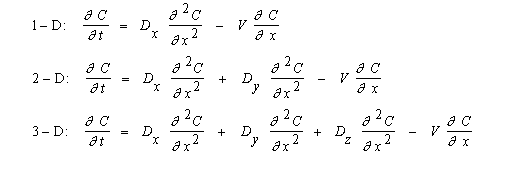
The governing equations for one, two, and three - dimensional chemical transport in
groundwater with advection and dispersion are (Bear, 1972):
Boundary Conditions and Solutions
Initially the groundwater aquifer has C=0 everywhere. Then at t=0 and x=0,
a chemical slug of mass, M, is injected instantaneously in the groundwater. If M is
injected uniformly across a groundwater aquifer's width and height, then there is dispersion only in
the x-direction (one-dimensional dispersion). If M is injected
uniformly across the groundwater aquifer's width, then dispersion occurs in the x and y
directions (two-dimensional dispersion). If M is injected at a point in the groundwater, then
dispersion occurs in all three dimensions x, y, and z.
The following solutions have been coded in our groundwater calculation (Bear, 1972):
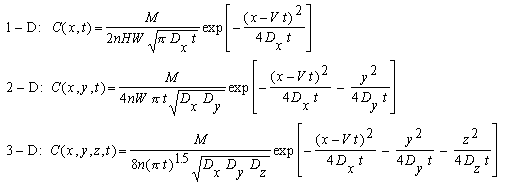
where:

Application Back to Calculation
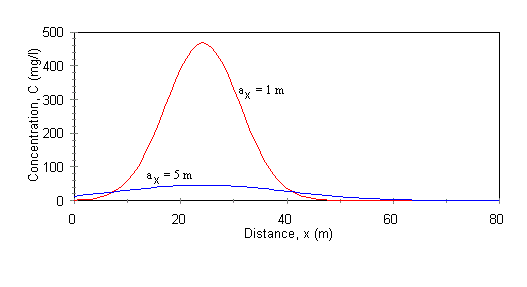
The following graph was developed to demonstrate effects of three-dimensional dispersion
in a sandy groundwater aquifer as predicted by the calculation. The following data were used:
(Click for variable definitions)
M = 100 kg, t = 1000 days, y = z = 0, ay = az
= ax /10.
K = 0.001 cm/s, n = 35%, ne = 25%, dh/dx = -0.007 m/m,
D* = 1.0x10⁻⁹ m2/s.
Therefore, V = 2.8x10⁻⁷ m/s, and Vt = 24.192 m.
Figure 1. Concentration profile at 1000 days for an injection of 100 kg
Variables Back to Calculation
The variables used on this groundwater web page are:
ax , ay , az = Dispersivities
in x, y, and z directions [L]. Varies from 0.1 to 100 m. Field and laboratory
tests have indicated that a varies with the scale of the groundwater test. Large scale
groundwater tests have higher a than small lab column tests. An approximate value for ax
is 0.1 times the scale of your system (Fetter, 1993). If you are simulating
groundwater contaminant transport in a 1 m long laboratory column, then ax~0.1
m. However, if you are simulating transport in a large groundwater aquifer greater than 1 km in
extent, then use ax~100 m. ay and az
are approximately ax /10 (Javandel et al., 1984, p. 12).
C = Chemical concentration [M/L3].
dh/dx = Groundwater hydraulic (or head) gradient [L/L]. Since
dh/dx is negative, we ask you to enter -dh/dx so that you can enter a
positive number for convenience. You determine dh/dx from two head
measurements using the equation, dh/dx = (h2-h1)/(x2-x1).
Dx , Dy , Dz = Dispersion
coefficients in x, y, and z directions [L2/T]. The equation D=a V +
D*/ne shown above is adapted from Ingebritsen and Sanford (1998).
D* = Molecular diffusion coefficient [L2/T].
Varies somewhat for different chemicals but a typical value to use is 1.0x10⁻⁹
m2/s (Fetter, 1993).
H = Groundwater aquifer height [L]. User enters if one-dimensional
dispersion.
K = Hydraulic conductivity of aquifer [L/T].
M = Chemical mass injected [M].
n = Total porosity of soil [%]. (Void volume/total volume)
x 100%.
ne = Effective porosity [%]. Porosity through
which flow can occur. A thin film of water bound to soil particles by capillary
forces does not move through the aquifer. ne is always ≤ n.
t = Time [T]. Time at which C is to be computed.
V = Pore water velocity in x-direction [L/T].
Also known as groundwater velocity.
W = Aquifer width [L]. User enters if one or
two-dimensional dispersion.
x, y, z = Distances [L]. Distances at which to compute C.
x is the direction of groundwater flow. y is the vertical
distance from the centerline of the plume. z is lateral distance (distance
into "the computer monitor") from the plume centerline.
Property Data
Back to Calculation
The following are tables of groundwater hydraulic conductivity, total porosity, and effective porosity. Parameter values have been compiled from a variety of sources such as Freeze and Cherry (1979), Hillel (1982), and Sanders (1998). The values used in the groundwater calculation are typical numbers within the ranges given below.
Table of Soil Properties
| Soil Type | Hydraulic Conductivity, K (cm/s) | Total Porosity, n (%) | Effective Porosity, ne (%) |
| Clayey | 10-9 - 10-6 | 40-60 | 0-5 |
| Silty | 10-7 - 10-3 | 35-50 | 3-20 |
| Sandy | 10-5 - 10-1 | 20-50 | 10-35 |
| Gravelly | 10-1 - 102 | 25-40 | 12-30 |
Errors Messages
Back to Calculation
"Cannot have 1D and Solve for y or z ." No computations. For one-dimensional dispersion, the chemical plume is uniformly distributed across the groundwater aquifer's height and width. y and z are not variables, so they cannot be computed.
"Cannot have 2D and Solve for z ." No computations. For two-dimensional dispersion, the chemical plume is uniformly distributed across the groundwater aquifer's width. z is not a variable, so it cannot be computed.
"H, W must be > 0." No computations. This error message will only appear in one-dimensional dispersion. Groundwater aquifer height and width must be entered, and they must be positive.
"W must be > 0." No computations. This error message will only appear in two-dimensional dispersion. Groundwater aquifer width must be entered, and it must be positive.
"Infeasible input." No computations. This error message will only appear if x, y, or z is being computed. This message will be shown if the ratio of mass to concentration entered is too low to be physically achievable.
"Certain inputs must be ≥ 0." No computations. C, D*, dh/dx, K, M, n, ne , and t must all be ≥ 0 if entered. x, y, and z can be positive, negative, or zero.
"n and ne must be ≤ 100%." No computations. Total porosity and effective porosity cannot exceed 100%.
"ne must be ≤ n." No computations. Effective porosity cannot exceed total porosity.
References
Back to Calculation
Bear, J. 1972. Dynamics of Fluids in Porous Media. American Elsevier Pub. Co.
Fetter, C. W. 1993. Contaminant Hydrogeology. Macmillan Pub. Co.
Freeze, R. A. and J. A. Cherry. 1979. Groundwater. Prentice Hall, Inc.
Hillel, D. H. 1982. Introduction to Soil Physics. Academic Press, Inc.
Ingebritsen, S. E. and W. E. Sanford. 1998. Groundwater in Geologic Processes. Cambridge University Press.
Javandel, I, C. Doughty, and C. F. Tsang. 1984. Groundwater Transport: Handbook of Mathematical Models. American Geophysical Union.
Sanders, L. L. 1998. A Manual of Field Hydrogeology. Prentice Hall, Inc.
© 2000-2026 LMNO Engineering, Research, and Software, Ltd. All rights reserved.
LMNO Engineering, Research, and Software, Ltd.
7860 Angel Ridge Rd. Athens, Ohio 45701 USA Phone: (740) 707‑2614
LMNO@LMNOeng.com
https://www.LMNOeng.com