
Units: cfs=ft3/s, cm=centimeter, ft=foot, gal=U.S.gallon, gpd=U.S. gallon per day, gpm=U.S. gallon per minute, km=kilometer, m=meter, s=second.
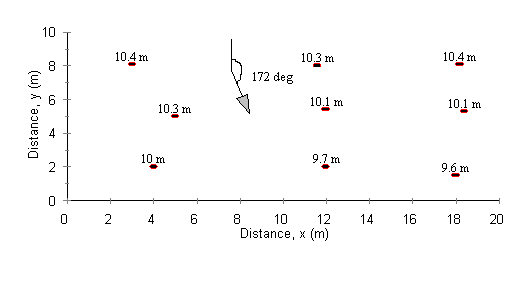
Plan View of Example Head Measurements in a Confined Aquifer.
Results of calculation: s = 172 degrees. dh/ds = -0.0971 m/m.
Introduction
The groundwater flow gradient and direction calculator allows the user to enter measured well (piezometer) levels in up to 10 groundwater observation wells. The results are most reliable if all of the groundwater wells are screened in the same formation and there are no discontinuities in the subsurface in the vicinity of the wells. For a confined aquifer, a geometric plane is fit through the (x, y, head) data. Then, the maximum downward slope of the plane is computed and reported as the groundwater gradient, dh/ds. The direction of the maximum slope of the plane is computed and reported as the groundwater flow direction, s. Groundwater flow direction is reported as degrees clockwise from the positive y-axis defined by your x,y locations. For an unconfined aquifer, the calculation squares the input heads, then fits a plane through these squared heads. The maximum groundwater gradient and flow direction are based on the plane formed by the squared heads. Since dh/ds varies with position in an unconfined aquifer, we report h(dh/ds), which is constant. Darcy's law is then used to compute groundwater flow per unit width of the formation.
Equations
The equation for a plane is z = A x + B y + C, where A, B, and C
are constants obtained by performing a best least squares fit of the plane equation
through the input data. For a confined aquifer z = h and for an
unconfined aquifer z = h2. To determine flow per unit width of
aquifer, Darcy's law is used:
For a confined aquifer, Q = - K H dh/ds
For an unconfined aquifer, Q = - K h dh/ds
The reason we use z = h2 for an unconfined aquifer is because Q =
- K h dh/ds = -0.5 K d(h2)/ds, so a plane in h2
exists.
Variable Definitions
The variables used on this web page are shown below. [L]=Length units and [T]=Time units.
A, B, C = constants determined by fitting the plane equation,
z = A x + B y + C, to the input data.
dh/ds = Steepest groundwater hydraulic gradient along plane formed by input
data for a confined aquifer [L/L]. Value will be negative since groundwater flows
from high head to low head. d is the symbol for derivative.
h dh/ds = Steepest composite gradient along plane formed by
input data (using h2) for an unconfined aquifer [L]. Value will
be negative since groundwater flows from high head to low head.
h = Head [L]. Entered by user. Can be positive,
negative, or zero for a confined aquifer. Must be ≥ 0 for an unconfined aquifer
H = Aquifer thickness [L]. User enters if confined aquifer
and Q is to be computed.
K = Hydraulic conductivity of aquifer [L/T]. User enters
if Q is to be computed.
Q = Groundwater flow rate per unit width of aquifer [L2/T or L3/T/L].
s = Groundwater direction of steepest gradient (i.e. direction of flow)
[degrees]. Measured clockwise from your y-axis.
x, y = Well locations [L] entered by user. Can be
positive, negative, or zero.
z = Used internally in groundwater calculation. For a confined
aquifer z = h and for an unconfined aquifer z = h2.
Groundwater Property Data
The following is a table of hydraulic conductivity for various aquifer materials. Values have been compiled from a variety of sources such as Freeze and Cherry (1979) and Sanders (1998). The values used in the groundwater gradient and flow calculation above are typical numbers within the ranges given below.
Table of Soil Properties
| Soil Type | Hydraulic Conductivity, (cm/s) |
| Clayey | 10-9 - 10-6 |
| Silty | 10-7 - 10-3 |
| Sandy | 10-5 - 10-1 |
| Gravelly | 10-1 - 102 |
Error Messages
"H must be > 0." No groundwater computations. H is saturated thickness. This error message can only occur for a confined aquifer and only if Q is to be computed.
"Invalid input." No groundwater computations. This error message occurs if non-numerical input.
"K must be > 0." No groundwater calculations. This error message will only occur if Q is to be computed.
"Unconfined heads must be ≥ 0." No groundwater computations. This error message can only occur for an unconfined aquifer.
"x,y coordinates do not form a plane." No groundwater calculations. x,y coordinates are in a straight line or all have the same x and y values forming a single point.
"Not computed" in an output field. Occurs if K ≤ 0, H ≤ 0, x,y coordinates are in a horizontal plane (i.e. zero gradient), or x,y coordinates do not form a plane.
References
Freeze, R. A. and J. A. Cherry. 1979. Groundwater. Prentice Hall, Inc.
Sanders, L. L. 1998. A Manual of Field Hydrogeology. Prentice Hall, Inc.
© 2000-2026 LMNO Engineering, Research, and Software, Ltd. All rights reserved.
LMNO Engineering, Research, and Software, Ltd.
7860 Angel Ridge Rd. Athens, Ohio 45701 USA Phone: (740) 707‑2614
LMNO@LMNOeng.com
https://www.LMNOeng.com