
Units: cfs=cubic foot per second, cm=centimeter, cP=centipoise, cSt=centistoke, ft=foot, g=gram, gal=U.S. gallon, gpd=U.S. gallon per day, gpm=U.S. gallon per minute, hp=horsepower, kg=kilogram, lb=pound, m=meter, min=minute, N=Newton, Pa=Pascal, psi=lb/inch2, s=second
Topics: Pipe Flow Scenarios Equations Minor Loss Coefficients Common Questions References
Introduction
The flow of liquids and gases through pipes is a fundamental phenomenon with profound implications across various industries and everyday life. Whether it's water coursing through household plumbing or natural gas transported across continents, understanding the dynamics of fluid flow is crucial for designing efficient systems and ensuring reliable operation. At its core, fluid dynamics governs how liquids and gases move through pipes. Key principles such as conservation of mass and energy guide the behavior of fluids in motion. The flow can be categorized broadly into two types: laminar and turbulent.
In laminar flow, the fluid moves in smooth, parallel layers with minimal disruption between them. This type of flow occurs at lower Reynolds numbers and is characterized by predictable paths of particles. Conversely, turbulent flow is chaotic and characterized by irregular streamlines. This type of flow occurs at higher Reynolds numbers.
Several factors influence the flow characteristics of liquids and gases in pipes. The Reynolds number is a dimensionless parameter that indicates the flow regime (laminar or turbulent) based on fluid velocity, viscosity, and pipe diameter. Higher Reynolds numbers correspond to turbulent flow. Viscosity determines the internal friction of the fluid and affects how easily it flows. High viscosity fluids (e.g., oils) tend to have more resistance to flow compared to low viscosity fluids (e.g., water). Smaller pipe diameters or rougher internal surfaces can increase frictional losses and promote turbulent flow at lower velocities.
The study of fluid flow in pipes finds extensive application across various fields. Municipal water supply networks rely on well-designed pipe systems to ensure reliable delivery to homes and businesses. Pipelines are crucial for transporting crude oil, natural gas, and refined petroleum products over long distances, often under high pressure and varying temperatures. Fluid flow in pipes is integral to many heat transfer processes, including HVAC (i.e. heating, ventilation, and air conditioning) systems, chemical reactors, and thermal power plants.
Designing efficient pipe systems involves balancing competing factors such as pressure drop, energy consumption, and material selection. Engineers continually innovate to optimize pipe designs. Environmental considerations drive advancements in pipeline safety, leak detection technologies, and the development of sustainable materials to minimize ecological impact.
The flow of liquids and gases in pipes is a complex yet essential aspect of modern engineering and everyday life. From ensuring clean water reaches our homes to facilitating the transport of energy resources, understanding fluid dynamics in pipes enables us to build safer, more efficient systems. As technology advances and challenges evolve, ongoing research and innovation will continue to shape the future of fluid transport systems, making them more reliable, sustainable, and responsive to global needs.
Discussion
Our pipe flow calculator is based on the steady state incompressible energy equation utilizing Darcy-Weisbach friction losses as well as minor losses. The pipe flow calculation can compute flow rate, velocity, pipe diameter, elevation difference, pressure difference, pipe length, minor loss coefficient, and pump head (total dynamic head). The density and viscosity of a variety of liquids and gases are coded into the pipe flow program, but you can alternatively select "User defined fluid" and enter the density and viscosity for fluids not listed. Though some industries use the term "fluid" when referring to liquids, we use it to mean either liquids or gases in our pipe flow calculator. The pipe flow calculation allows you to select from a variety of piping scenarios which are discussed below.
Comments on gas flow
As mentioned above, the equations that our pipe flow calculator is based upon are for
incompressible flow. The incompressible flow assumption is valid for liquids. It is also
valid for gases if the pressure drop is less than 40% of the upstream pressure. Crane
(1988, p. 3-3) states that if the pressure drop is less than 10% of the upstream gage
pressure (gage pressure is pressure relative to atmospheric pressure) and an
incompressible model is used, then the gas density should be based on either the upstream
or the downstream conditions. If the pressure drop is between 10% and 40% of the upstream
gage pressure, then the density should be based on the average of the upstream and
downstream conditions. If the pressure drop exceeds 40% of the upstream gage pressure,
then a compressible pipe flow model, like the Weymouth, Panhandle
A, or Panhandle B should be used.
Pipe Flow Scenarios
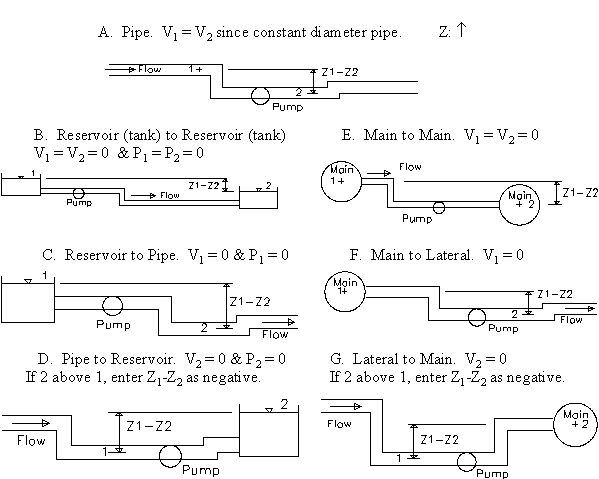
Since boundary conditions affect the flow characteristics, our pipe flow calculator allows you to select whether your locations 1 and 2 are within pipes, at the surface of open reservoirs, or in pressurized mains (same as pressurized tank). If there is no pump between locations 1 and 2, then enter the pump head (Hp) as 0.
Steady State Energy Equation
Back to Calculation
The first equation shown is the steady state energy equation for incompressible pipe flow. The left side of the equation contains what we call the driving heads. These heads include heads due to a pump (if present), elevation, pressure, and velocity. The terms on the right side are friction loss and minor losses. Friction losses are computed using the Darcy Weisbach friction loss equation. The friction factor for turbulent flow is found using the Colebrook equation which represents the Moody diagram. f is the Moody friction factor. The pipe flow equations are well-accepted in the field of fluid mechanics and can be found in many references such as Cimbala and Cengel (2008), Munson et al. (1998), and Streeter et al. (1998).
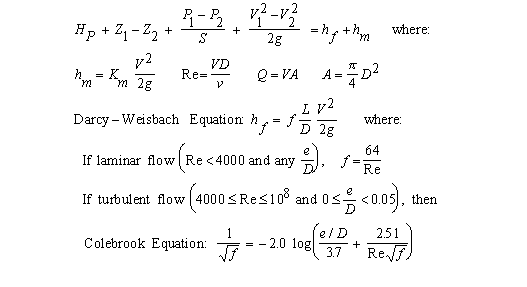
The pipe flow equations above are dimensionally correct which means that the units for the variables are consistent. A consistent set of English units would be mass in slugs, weight and force in pounds, length in feet, and time in seconds. SI units are also a consistent set of units with mass in kilograms, weight and force in Newtons, length in meters, and time in seconds. Our pipe flow calculator allows you to enter a variety of units and automatically performs the unit conversions.
Variable Definitions
A = Pipe cross-sectional area, ft2 or m2.
D = Pipe diameter, ft or m.
Driving Head (DH) = left side of the first equation (or right side of the equation), ft or
m. This is not total dynamic head.
e = Pipe surface roughness, ft or m. Select from the drop-down menu in our calculation. Additional values.
f = Moody friction factor, unit-less. Do not confuse the Moody f with the Fanning friction
factor. f = 4 fFanning .
g = acceleration due to gravity = 32.174 ft/s2 = 9.8066 m/s2.
hf = Major (friction) losses, ft or m.
hm = Minor losses, ft or m.
Hp = Pump head (also known as Total Dynamic Head), ft or m.
Km = Sum of minor losses coefficients. See Table of Minor Loss Coefficients
below.
log = Common (base 10) logarithm.
Pump Power (computed by program) = SQHp, lb-ft/s or N-m/s. Theoretical
pump power. Does not include an inefficiency term. Note that 1 horsepower = 550 ft-lb/s.
P1 = Upstream pressure, lb/ft2 or N/m2.
P2 = Downstream pressure, lb/ft2 or N/m2.
Re = Reynolds number, unit-less.
Q = Flow rate in pipe, ft3/s or m3/s.
S = Weight density, lb/ft3 or N/m3.
V = Velocity in pipe, ft/s or m/s.
V1 = Upstream velocity, ft/s or m/s.
V2 = Downstream velocity, ft/s or m/s.
Z1 = Upstream elevation, ft or m.
Z2 = Downstream elevation, ft or m.
ν = Kinematic viscosity, ft2/s or m2/s. Note that kinematic
viscosity = dynamic viscosity divided by density.
All of our calculations utilize double precision. Newton's method (a numerical method) is used to solve the Colebrook equation accurate to 8 significant digits. A cubic solver (numerical method) is used for "Solve for V, Q," "Q known. Solve for Pipe Diameter," and "V known. Solve for Pipe Diameter." More than one solution is possible for these three calculations since there could be a result in the laminar range and the turbulent range. There may even be two possible results in the laminar range for "Solve for V, Q" if scenario D or G is selected. All of the possible solutions are computed and output. If multiple solutions are computed, please click in the numeric field and click the right arrow key to see all of the digits. If you have selected "Q known. Solve for Pipe Diameter," and scenario D or G, you must enter Km >1. All calculations are analytic (closed form) except as mentioned here.
Table of Minor Loss Coefficients (Km is unit-less) Back to Calculation
| Fitting | Km | Fitting | Km |
| Valves: | Elbows: | ||
| Globe, fully open | 10 | Regular 90°, flanged | 0.3 |
| Angle, fully open | 2 | Regular 90°, threaded | 1.5 |
| Gate, fully open | 0.15 | Long radius 90°, flanged | 0.2 |
| Gate 1/4 closed | 0.26 | Long radius 90°, threaded | 0.7 |
| Gate, 1/2 closed | 2.1 | Long radius 45°, threaded | 0.2 |
| Gate, 3/4 closed | 17 | Regular 45°, threaded | 0.4 |
| Swing check, forward flow | 2 | ||
| Swing check, backward flow | infinity | Tees: | |
| Line flow, flanged | 0.2 | ||
| 180° return bends: | Line flow, threaded | 0.9 | |
| Flanged | 0.2 | Branch flow, flanged | 1.0 |
| Threaded | 1.5 | Branch flow, threaded | 2.0 |
| Pipe Entrance (Reservoir to Pipe): | Pipe Exit (Pipe to Reservoir) | ||
| Square Connection | 0.5 | Square Connection | 1.0 |
| Rounded Connection | 0.2 | Rounded Connection | 1.0 |
| Re-entrant (pipe juts into tank) | 1.0 | Re-entrant (pipe juts into tank) | 1.0 |
Common Questions
Back to Calculation
I took fluid mechanics and learned about pipe flow calculations a long long time ago. What is head? Why does it have
units of length? Head is energy per unit weight of fluid (i.e. Force x
Length/Weight = Length). The pipe flow calculator on this page solves the energy equation (shown
above); we call energy "head."
Why is Pressure=0 for a reservoir? A reservoir is open to the atmosphere, so its
gage pressure is zero.
Why is Velocity=0 for a reservoir? This is a common assumption in fluid
mechanics and is based on the fact that a reservoir has a large surface area. Therefore,
the liquid level drops very little even if a lot of liquid flows out of the
reservoir. A reservoir may physically be a lake or a large diameter tank.
What is a "main" and a "lateral"? A "main" is
a large diameter supply pipe that has many smaller diameter "laterals" branching
off of it. In fluid mechanics, we set V=0 for the main since it has a large diameter
(relative to the lateral) and thus a very small velocity. To further justify the V=0
assumption, the main's pressure is typically high, so the velocity head in the main is
negligible. The main is drawn such that it is coming out of your computer monitor.
Can I calculate pipe flow between two reservoirs using either Scenario B or E? Yes,
you can. If using Scenario E, just set P1-P2=0. Scenario B
automatically sets P1-P2=0.
Can I calculate pipe flow between two mains using either Scenario B or E? Only if the
pressure is the same in both mains.
How do I model a pipe discharging freely to the atmosphere? Use Scenario A,
C, or F. Since P2=0 (relative to atmospheric pressure), P1‑P2
that is input or output will be P1.
What are minor losses? Minor losses in pipe flow calculations are head (energy) losses due to valves,
pipe bends, pipe entrances (for fluid flowing from a tank to a pipe), and pipe exits
(fluid flowing from a pipe to a tank), as opposed to a major loss which is due to the
friction of fluid flowing through a length of pipe. Minor loss coefficients (Km)
are tabulated below. For our pipe flow calculator, all of the pipes have the same diameter, so
you can add up all your minor loss coefficients and enter the sum in the Minor Loss
Coefficient input box.
Why do I sometimes get the message when running the pipe flow calculator, "Infeasible Input"? The
governing equations for fluid flow must be satisfied. Fluids must flow from higher energy
to lower energy; driving head must always be > 0. Pipe roughness, fluid
viscosity, pipe diameter, and velocity must be such that the Reynolds number is ≤108
and other conditions shown with the pipe flow equations below are satisfied. It is possible to
enter values into the pipe flow calculator that are not physically or mathematically feasible.
I'm confused about pumps. Only input Pump Head if the pump is between points
1 and 2. Otherwise, enter 0 for Pump Head. Pump Head, Hp, is also
known as total dynamic head.
Your pipe flow calculator is great! What are its limitations? Pipes must all have
the same diameter. Pump curves cannot be implemented.
What is Driving Head? See above in the variable definitions.
References
Back to Calculation
Cimbala, John M. and Yunus A. Cengel. 2008. Essentials of Fluid Mechanics: Fundamentals and Applications. McGraw-Hill.
Crane Co. 1988. Flow of Fluids through Valves, Fittings, and Pipe. Technical Paper 410 (TP-410).
Munson, Bruce R. Donald F. Young, and Theodore H. Okiishi. 1998. Fundamentals of Fluid Mechanics. John Wiley and Sons. Inc. 3ed.
Streeter, Victor L., E. Benjamin Wylie, and Keith W. Bedford. 1998. Fluid Mechanics. McGraw-Hill. 9ed.
© 1999-2026 LMNO Engineering, Research, and Software, Ltd. All rights reserved.
LMNO Engineering, Research, and Software, Ltd.
7860 Angel Ridge Rd. Athens, Ohio 45701 USA Phone: (740) 707-2614
LMNO@LMNOeng.com
https://www.LMNOeng.com