
Units: cm=centimeter, ft=foot, gal=US gallon, hr=hour, m=meter, MGD=Million Gallons (US) per Day, min=minute, s=second.
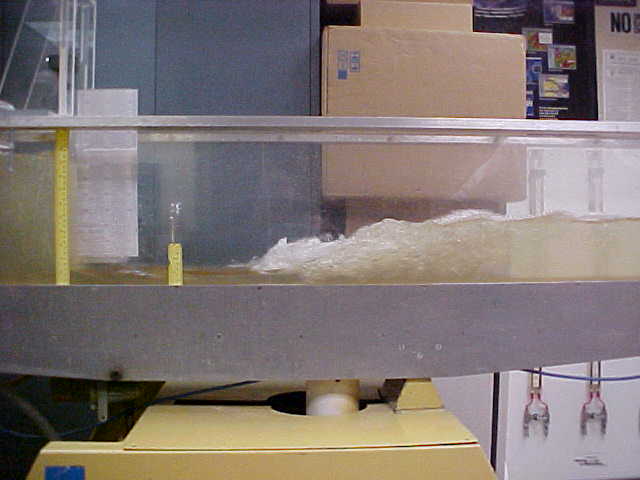
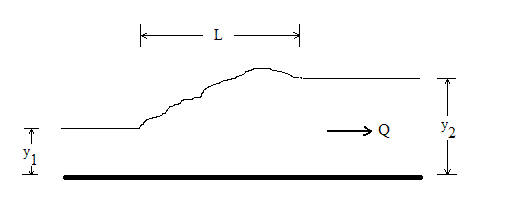
Photograph from Ohio University's Fluid Mechanics Laboratory. Athens, Ohio USA
Equations
Equations for hydraulic jump in horizontal rectangular channel (Chaudhry, 1993; Chow, 1959):
Q = V1 Y1 B = V2 Y2 B F1 = V1 / (g Y1)0.5 F2 = V2 / (g Y2)0.5
Y2/Y1 = 0.5 [(1+8F12 )0.5 - 1] L = 220 Y1 tanh[(F1-1)/22] h = (Y2-Y1)3 /( 4 Y1 Y2)
where (subscript 1 indicates upstream of jump; subscript 2 indicates
downstream of jump):
B=Channel width (m), F=Froude number (dimension-less), g=acceleration due to gravity
(9.8066 m/s2), h=Head loss (m), L=Length of jump (m), Q=Discharge (m3/s),
tanh=Hyperbolic tangent trigonometric function, V=Velocity (m/s), Y=Water depth (m)
What is a Hydraulic Jump?
A hydraulic jump occurs when the upstream flow is supercritical (F>1). To have a jump, there must be a flow impediment downstream. The downstream impediment could be a weir, a bridge abutment, a dam, or simply channel friction. Water depth increases during a hydraulic jump and energy is dissipated as turbulence. Often, engineers will purposely install impediments in channels in order to force jumps to occur. Mixing of coagulant chemicals in water treatment plants is often aided by hydraulic jumps. Concrete blocks may be installed in a channel downstream of a spillway in order to force a jump to occur thereby reducing the velocity and energy of the water. Flow will go from supercritical (F>1) to subcritical (F<1) over a jump.
According to Chow (1959), a strong jump occurs when F1>9, a steady jump occurs when 4.5<F1<9, an oscillating jump occurs when 2.5<F1<4.5, a weak jump occurs when 1.7<F1<2.5, and an undular jump occurs when 1<F1<1.7. According to Chaudhry (1993), the best jumps occur when 4.5<F1<9.
Messages
"Need B>0." Channel width must be a positive number.
"Need Q>0." Discharge must be positive.
"Need Y1>0." Upstream depth must be
positive.
"Need F1 >1." Upstream flow must be
supercritical.
References
Chaudhry, M. H. 1993. Open Channel Flow. Prentice-Hall, Inc.
Chow, V. T. 1959. Open Channel Hydraulics. McGraw-Hill, Inc.
© 1999-2026 LMNO Engineering, Research, and Software, Ltd. All rights reserved.
LMNO Engineering, Research, and Software, Ltd.
7860 Angel Ridge Rd. Athens, Ohio 45701 USA Phone: (740) 707-2614
LMNO@LMNOeng.com
https://www.LMNOeng.com